All posts by admin

Want to explore alternate tunings? Now it’s easy.


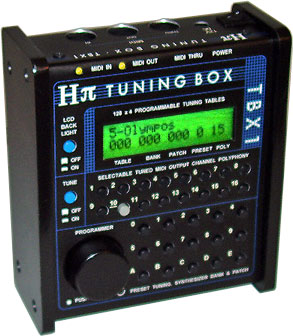
H-Pi has released a new, updated version of their Tuning Box. It does any arbitrary tuning setup, from Archytas Septimal to Just to Harry Partch’s 43-Tone Chromelodeon Scale to Johnston Enharmonic. You name it, if your MIDI synthesizer accepts pitch bend, this device ($299 is an amazing price) will generate the correct MIDI messages to make any alternate tuning or key reassignment desired. I’ve already ordered one for my own experimentation.

—————————

H-Pi also had something on its website that amused me.

Remember my post about unusual MIDI controllers last March? Well……

The New York Times ran a strangely familiar article four months later…..

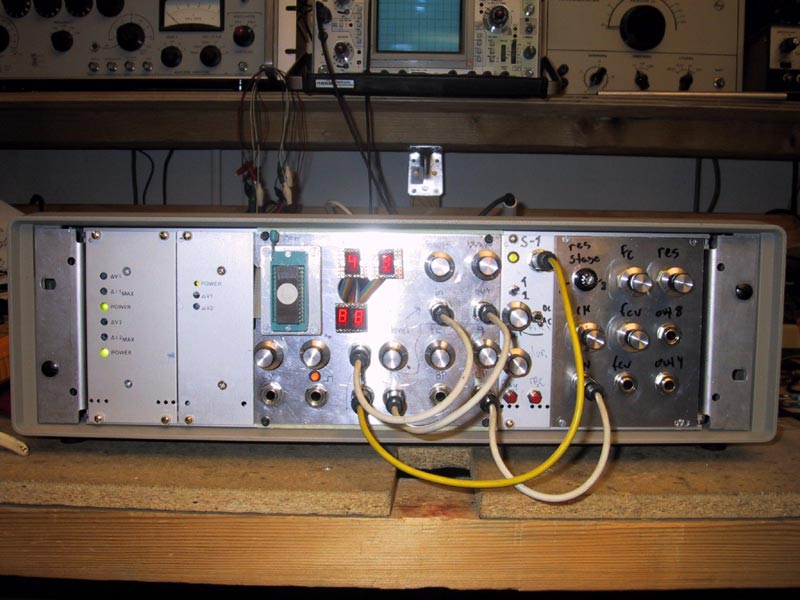
The Electronic Peasant strikes again…..with a banjo synthesizer

His new pitch-CV processor and synthesizer was intended for processing the output of a banjo pickup with separate outputs for each string. Based on a Harry Bissell pitch-CV processor. The quality of the Peasant’s construction will embarrass most DIYers. (Not to mention his homebrew modular synth.) If you like to read about alternate controllers, here is a perfect example. How many other banjo players do you know of who build their own synthesizers?

And not only that, he has a lady friend, who is learning to DIY music electronics.

The Brutal Blinky

A synth made of neon lamps, from Not Breathing.
Videos of the Blinky in action: 1, 2

Quote from the maker:

5 neons in a ring counter type set up with a pot and cap value change for each stage,
a multivibrator modulator w/ 2 neons – rate pot, shape pot – range switch, switch o/off to ring counter.
different one w/out shape pot or range switch – depth pot – switch to power it from b+ or the previous multivibrator and switch on/off to the ring counter.
a third single neon osc as modulator w/ just rate pot, switch from b+ or previous modulator, on/off to ring counter
subosc divider, i grabbed from your vco circuit i believe, w/ a range switch,
and a 12 stage passive low pass filter (the magic part)

Not Breathing STRIKES AGAIN

With the Astra. Video here.

I quote the creator:
“ken stone power supply board – caps/regulator/heatsinks/diodes from gutted wersi organ.
ray wilson’s 1v/oct single bus pcb. the keyboard is from a gutted lowrey wandering genie keyboard.
i recycled most of the capacitors in the unit from the genie and a dead tr606
(the rotary switches from 606 and a dead scope)
inside five small protoboards w/ 2 VCOs based on thomas henry’s 3080 vcos
(w/ matched transistor pair/tempco/polystrene caps).
white noise source (based on henry’s PNP noise source) through a Lm386 amp.
passive ring modulator using BAT56 schottky diodes – through their own lm386 amp.
VCF is a CEM 3328 from a dead mirage keyboard following jeff pointus/scott stites schematic – thomas henry 3080 VCA – a 555 based ADSR, two asm-1 lfos.
whew.
each CV section has it’s own modulation matrix rotary switch w/ choice
of lfo 1 tri, lfo 1 squ, lfo2 tri/squ, adsr, noise, gate, vco cross modulation
i didn’t buy anything for this unit.
i used some pretty crappy pots – but used good ones where it counts –
even the wire was from an old medical device

this is my depression era thrifter

the unit has linear FMs to the vcos and voltage controled Q
that are not even available on the front panel 🙂
i also built another lag in the unit – but didn’t need it…
someone can circuit bend it when i’m dead….

used decal paper for the first time to do the panel –
wood was dumpster wood

assembly of a mad man…”

But smarter than most mad men……and not afraid to part out crummy old combo organs. 😉
Even more what-the-hell-is-this stuff…..

Yet another Flickr gallery of pics of a homebrew synthesizer. No idea what it was or if he even finished it. The PC board looks like a kit but I don’t recognize it.

A Swedish DJ who is building a modular synth–apparently.

And here’s a really good photoset from the AHBA synth meeting last September. I don’t think Matrix ran this one.

Finally. Manmachine is a great comic. And features a “homebrew analog synthesizer”. Which the robot-oid protagonist apparently blows up after connecting power. (Scroll to the right using your mouse.) The creator ought to be encouraged to make more.

Rare inside views of two legendary modular synths.

First, in 2007 Matrix covered Greg Danner’s restoration of the notorious Sal-Mar Construction, an obscenely complex synthesizer from 1969 controlled by digital logic sequencers. What you didn’t know: Greg has a Flickr account full of photos of the restored Sal-Mar.

Also in 1969, Joel Chadabe had Moog build a modular synth along roughly similar lines–no keyboard, lots of sequencers. The innards of the CEMS are documented here.

Things you won’t see on Matrixsynth. :P

First, the Infinite Response folding keyboard. I’ve seen folding keyboards before, but never one this nicely made. Even has a magnesium chassis.

Second, the Fender electric version of the Takaratomy Air Guitar. Now available from acgears.com. They also sell the acoustic version that Matrix ran a video of long ago, plus the FM3 Buddha Machine.

Also the Ta Horng iSmart roll-up soft keyboard.

And MiJam’s Pro Air Drummer. You can still buy some amazing gadgets at Toys R Us. In fact, MiJam makes all kinds of clever and great music toys. Most of which Matrix has never mentioned……

sorry for the quiet time

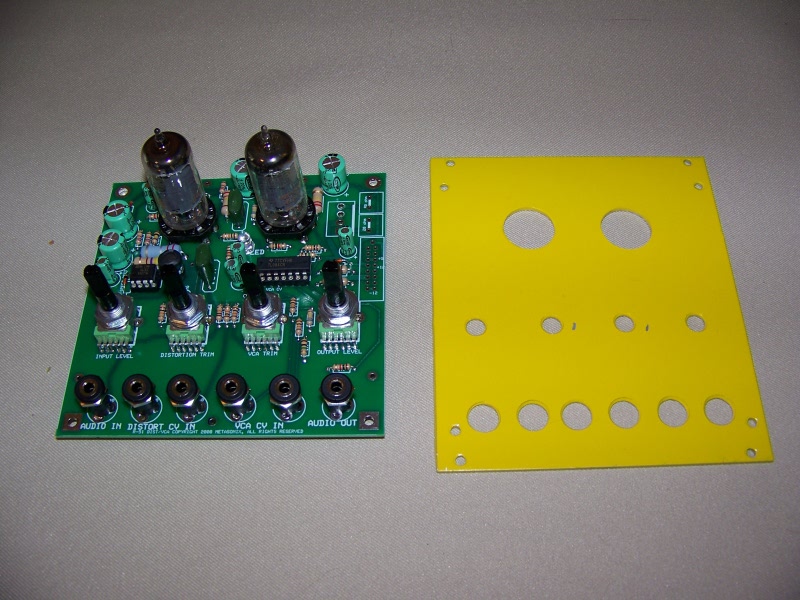
Not many people have been posting to DS lately. So let me fill in with a new photo–this is the first of the Eurorack modules that Metasonix will introduce in 2009. First one is a combined tube distortion/VCA, using variable-mu pentodes (26A6s to be specific). Shown here is the first prototype. I’ve built 2 more, and they all work exactly alike, so it’s a solid and reliable design. Hopefully it will be ready to show at NAMM.r series module prototype

Loud Objects’ Noise Toy


The Noise Toy is one of the simplest electronic kits I’ve ever seen. It’s an AVR microprocessor on a tiny board–apparently the smallest AVR available. You program it with software to make noises. This requires an AVR programmer and some knowledge of embedded-system programming (although the programming SW they recommend makes it fairly easy).

One thing I don’t get: what’s with the giant power switch?